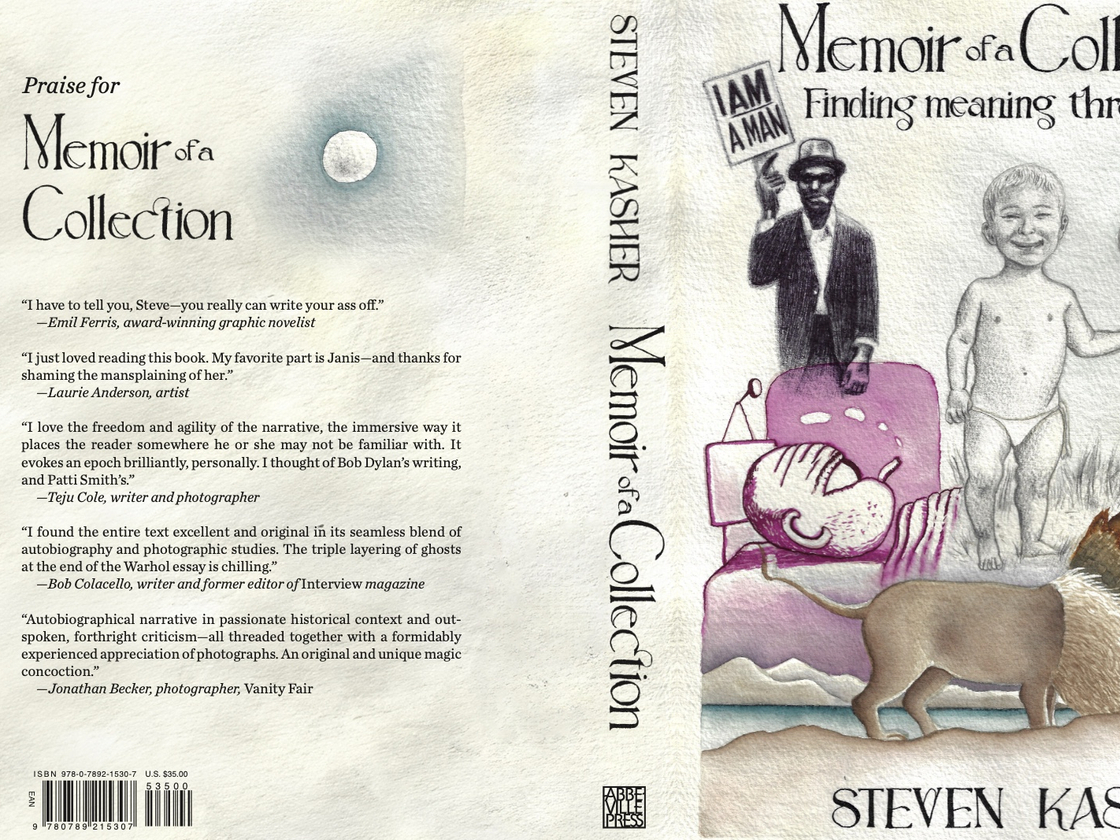
Grid-1up

Memoir of a Collection: Finding Meaning Through Art

Available for preorder now and in stores March 31st. Published by Abbeville Press.

In Memoir of a Collection, Steven Kasher retraces his own path through the art world as an artist, curator, writer, dealer, and collector. The book unfolds as a series of encounters—with artworks, artists, and historical moments—that together form a portrait of a life shaped by looking closely.

“Art is not just something we admire on walls,” Kasher writes. “It’s something we carry with us. The images that matter to us become part of our memory and our moral imagination.”

Part memoir, part art criticism, and part philosophical inquiry, the illustrated volume brings together a series of linked essays in which Kasher examines the images that left a lasting mark on him. Kasher shares stories of artists he knew personally—including Philip Guston, John Chamberlain, June Leaf, and Robert Frank—and photographers whose work he helped bring to broader audiences, among them Ernest Withers, Mike Disfarmer, and Charles Moore. The book evokes a wide cultural landscape populated by musicians, writers, and filmmakers whose work intersected with Kasher’s life in New York’s creative communities. Figures such as Lou Reed and Laurie Anderson appear alongside references to Janis Joplin and Leonard Cohen, reflecting the cross-pollination of artistic circles that defined the era.

Personal history plays an equally important role. Kasher reflects on growing up as a second-generation Jewish American shaped by the memory of the Holocaust and the moral urgency of the Civil Rights Movement—historical forces that profoundly informed his curatorial and scholarly interests.

Illustrated with more than 125 images, Memoir of a Collection invites readers to reflect on the works that have shaped their own lives. By examining artworks ranging from anonymous photographs to museum masterpieces—and even digital images circulating on social media—Kasher suggests that the act of looking can become a form of personal inquiry.

Ultimately, the book proposes a democratic approach to art: that meaning is not fixed by institutions or critics but discovered through the viewer’s own experiences and memories. “This book is an invitation,” Kasher writes. “To look at the images around you, to ask what they mean to you, and to discover what they reveal about who you are.”

You can pre-order the book here Amazon or at your favorite bookseller.


Highlights

Memoir of a Collection

Steve's new book will be in stores March 31st. Published by the redoubtable Abbeville Press.

In Memoir of a Collection, Steve retraces his own path through the art world as an artist, curator, writer, dealer, and collector. The book unfolds as a series of encounters—with artworks, artists, and historical moments—that together form a portrait of a life shaped by looking closely.

“Art is not just something we admire on walls,” Steve writes. “It’s something we carry with us. The images that matter to us become part of our memory and our moral imagination.”

Part memoir, part art criticism, and part philosophical inquiry, the illustrated volume brings together a series of linked essays in which Steve examines the images that left a lasting mark on him. Steve shares stories of artists he knew personally—including Philip Guston, John Chamberlain, June Leaf, and Robert Frank—and photographers whose work he helped bring to broader audiences, among them Ernest Withers, Mike Disfarmer, and Charles Moore. The book evokes a wide cultural landscape populated by musicians, writers, and filmmakers whose work intersected with Steve’s life in New York’s creative communities. Figures such as Lou Reed and Laurie Anderson appear alongside references to Janis Joplin and Leonard Cohen, reflecting the cross-pollination of artistic circles that defined the era.

Personal history plays an equally important role. Steve reflects on growing up as a second-generation Jewish American shaped by the memory of the Holocaust and the moral urgency of the Civil Rights Movement—historical forces that profoundly informed his curatorial and scholarly interests.

Illustrated with more than 125 images, Memoir of a Collection invites readers to reflect on the works that have shaped their own lives. By examining artworks ranging from anonymous photographs to museum masterpieces—and even digital images circulating on social media—Steve suggests that the act of looking can become a form of personal inquiry.

Ultimately, the book proposes a democratic approach to art: that meaning is not fixed by institutions or critics but discovered through the viewer’s own experiences and memories. “This book is an invitation,” Steve writes. “To look at the images around you, to ask what they mean to you, and to discover what they reveal about who you are.”

PREORDER HERE!


Tara Booth Wins Eisner!

The great Tara Booth just won the Eisner (the Oscar of comics/graphic novels). Category: Humor Publication. For her book Processing. A compendium of 100 painted stories that make us laugh/cry. Congrats, Tara!!

Original paintings on paper for sale. Call or email me.

McDarrah Archive Donated to New York Historical

MUUS Collection has donated the Fred W. McDarrah Estate to The New York Historical, New York’s first museum. The McDarrah Estate includes approximately 51,000 prints,  200,000 negatives, 9,000 contact sheets, and related ephemera. The New York Historical is one of the premier institutions for historical research and exhibitions in the United States.

You can can explore four exhibitions and 25 press items about Fred here: www.stevenkasher.com/artists/fred-w-mcdarrah

Read the donation announcement here: https://www.muuscollection.com/post/donation-announcement-the-fred-w-mcdarrah-estate